What Is a Hanging Glacier? Swiss Village Randa Stays on Alert Over Weisshorn’s 3 Lakh Cubic Metre Ice Block, and Why the Himalayas Face the Same Risk
A 300,000 cubic metre ice block on Switzerland’s Weisshorn glacier has kept Randa on alert. What hanging glaciers are, why they collapse, and the risk in India’s Himalayas.
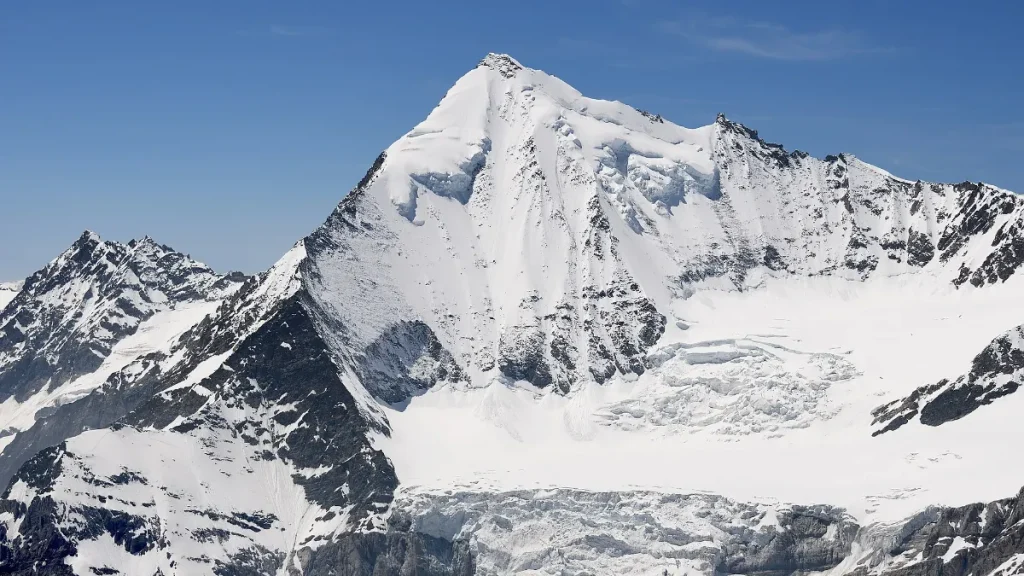
Photo: Carsten Steger / CC BY-SA 4.0, via Wikimedia Commons
“Hanging glacier” turned up among India’s trending science searches this week, and the reason lies in the Swiss Alps. Above the village of Randa in the canton of Valais, a block of ice of about 3 lakh (300,000) cubic metres is hanging from the east face of the Weisshorn, one of Switzerland’s highest peaks, and moving downhill by up to 20 centimetres a day. Local authorities announced on 27 October that their precautionary measures will stay in force.
It is a story from far away, but the same kind of ice sits above many valleys in the Indian Himalayas.
What is a hanging glacier?
A hanging glacier is a glacier that ends abruptly on a steep slope or cliff, high above the valley floor, instead of flowing gently down into the valley. Think of ice spilling over the edge of a rock ledge. Because its front edge is unsupported, pieces of it break off from time to time. Small falls are normal. The danger comes when a large mass breaks away at once, which glaciologists call a calving event or ice avalanche.
What is happening at Randa
- The ice block sits on the Weisshorn’s eastern hanging glacier, above the Bis glacier plateau.
- Movement has been monitored since late June 2026, when a danger zone was marked out.
- After several icefalls in mid-August and a sharp increase in movement, authorities raised the warning to their third level.
- Nobody is allowed in the danger zone, and official walking and cycling routes through it remain closed. The village’s residential area is not affected.
- Officials worry that heavy fresh snow on the plateau below could make a large ice fall travel further.
Randa knows the risk well. The biggest recorded collapse from the Weisshorn, in 1819, caused extensive damage in the village. Smaller ones in 1972 and 1973 stopped on the glacier field. In 1991, separate rock landslides at Randa buried the railway and road and dammed the Vispa river.
Why hanging glaciers are becoming more dangerous
Rising temperatures are changing how glaciers behave. Warmer conditions can bring meltwater to the base of the ice, where it acts like a lubricant, and thawing permafrost weakens the rock that the ice is frozen to. Scientists say this makes sudden collapses harder to predict, especially on steep slopes.
The Himalayan connection
India has its own hanging glaciers, many of them high above river valleys in Uttarakhand, Himachal Pradesh, Ladakh and Sikkim, where villages, roads and hydropower projects lie downstream. Earlier this year, the National Green Tribunal took up the danger posed by hanging glaciers in the central Himalayas on its own and issued notices to the Centre and government bodies. Researchers have long linked the February 2021 Chamoli disaster in Uttarakhand, in which a huge mass of rock and ice crashed into the Rishiganga valley, to this kind of slope failure.
Switzerland’s approach at Randa, with continuous monitoring, marked danger zones and early warnings, is the model experts want for vulnerable Himalayan valleys. That means radar and camera monitoring of the riskiest glaciers, clear evacuation plans and limits on building in the path of potential ice and debris flows.
What it means for travellers from Pune
Pune sends large numbers of trekkers and pilgrims to Uttarakhand and Himachal every year, for Kedarnath, Badrinath, Hemkund and Himalayan treks. Check local weather and disaster management advisories before you go, follow closures, and do not camp on river beds or under steep ice slopes.
For more science stories, see our report on the Martian meteorite found in the Sahara and our explainer on El Nino and La Nina in 2026.
Frequently asked questions
What is a hanging glacier?
A glacier that ends abruptly on a steep slope or cliff high above a valley, so that pieces of ice can break off and fall as ice avalanches.
Why is Randa in Switzerland on alert?
Because an ice block of about 300,000 cubic metres on the Weisshorn’s eastern hanging glacier is moving downhill by up to 20 cm a day and could break off.
Are there hanging glaciers in India?
Yes. Many hanging glaciers sit above valleys in the Indian Himalayas, and the National Green Tribunal took up the risk they pose in the central Himalayas in 2026.