Teghaza 001: Martian Meteorite Found in Sahara Is 4.1 Billion Years Old, Among the Oldest Pieces of Mars
Scientists say Teghaza 001, found in the Sahara, is a 4.1-billion-year-old piece of Mars, among the oldest Martian meteorites known. What it tells us.
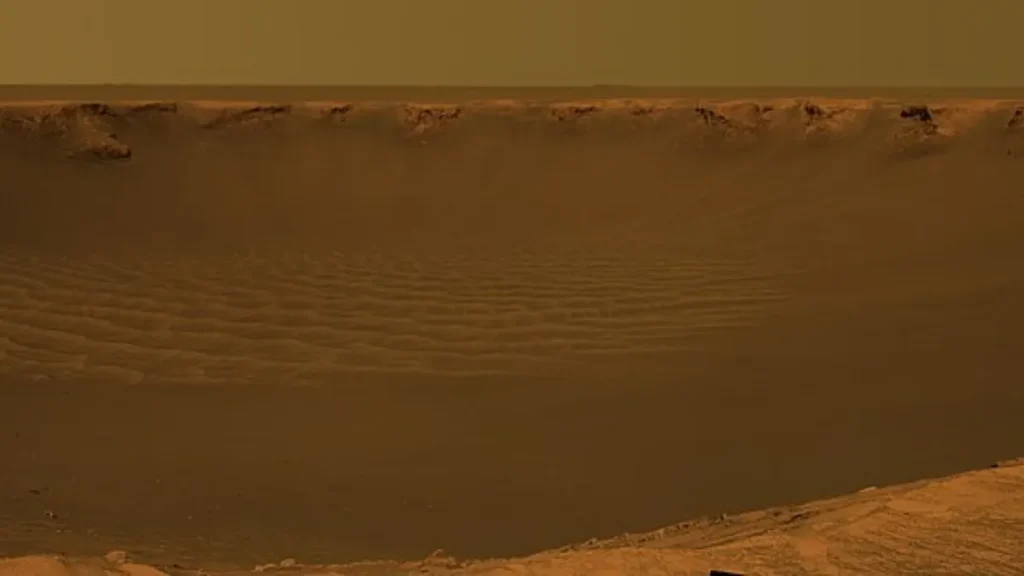
Photo: NASA/JPL-Caltech/Cornell / Public domain, via Wikimedia Commons
Pune, 1st November 2026: A set of reddish rocks picked up in the Sahara four years ago has turned out to be one of the oldest pieces of Mars ever found on Earth. Scientists say the meteorite, named Teghaza 001, formed about 4.1 billion years ago.
The dating study was published on Thursday, 29 October, in the journal Science, NASA’s Jet Propulsion Laboratory said. The lead author is Yang Liu, a planetary scientist at JPL in California.
What was found
The meteorite is named after an abandoned salt-mining settlement in Mali, near where the rocks were found. The rock weighs about 800 grams, nearly two pounds, and was recovered in 2022 as eight pieces, Live Science reported.
How scientists dated it
Based on its oxygen isotopes, it was first classified as a shergottite, the most common and usually much younger type of Martian meteorite. But Liu found zircon crystals inside, which are unusual in shergottites. The team dated the zircons, and a Caltech group led by Francois Tissot confirmed the age with a rubidium-strontium method on single mineral grains, using a sample smaller than a fingernail.
“It was only after we started looking closely that we realized this meteorite is really unique,” Liu said.
Of roughly 435 known Martian meteorites, JPL counts it among the three most ancient, alongside Allan Hills 84001 and Northwest Africa 7034, nicknamed “Black Beauty”. ALH84001 is made almost entirely of one mineral, and Black Beauty is a mix of older volcanic fragments that came together about 2.1 billion years ago, so Teghaza 001’s mix of igneous minerals is what makes it special.
“This is really our first piece of Martian crust from a part of Mars we’ve never had a sample of before,” said second author Lee Saper, now at NASA Ames.
What it reveals about early Mars
The rock preserves a snapshot of Mars just a few hundred million years after the planet formed, offering clues about its early mantle and crust.
An earlier study, published in Science Advances in June, found water locked inside a mineral called apatite in the meteorite, pointing to abundant water on early Mars. High levels of deuterium suggest much of that water had already escaped into space by then, as sunlight split water molecules and hydrogen drifted away.
Some of the water came from magma rising from deep inside the planet, and some seeped down from the surface and atmosphere. The mantle portion of the rock also has an unusual mix of elements, suggesting it is more primitive than other Martian samples.
Where on Mars did it come from?
That is still unknown. Comparing its minerals with orbital data has narrowed it down to 13 possible locations in Mars’s heavily cratered southern highlands. When it was blasted off Mars and when it landed in the Sahara are also unknown.
Pune has its own strong space-science community; read how astronomers at IISER Pune and NCRA-TIFR used the GMRT to spot a giant radio galaxy with four jet episodes. More stories in our science section.
Frequently asked questions
How old is the Teghaza 001 Martian meteorite?
Scientists dated it to about 4.1 billion years, making it one of the oldest Martian meteorites known.
Where was the Martian meteorite found?
It was found in the Sahara, and named after Teghaza, an abandoned salt-mining settlement in Mali near the find site.
How do scientists know the meteorite came from Mars?
Its oxygen isotopes match those of other Martian meteorites, and its minerals match orbital data from 13 locations on Mars.
What does the meteorite tell us about water on Mars?
Water locked in its minerals suggests early Mars had abundant water, much of which had already escaped to space.