Pune Astronomers Find Giant Radio Galaxy With Four Episodes of Jet Activity Using GMRT; First Such Case Known
Scientists from IISER Pune and NCRA-TIFR used the GMRT near Narayangaon to find a giant radio galaxy that has switched its jets on four separate times.
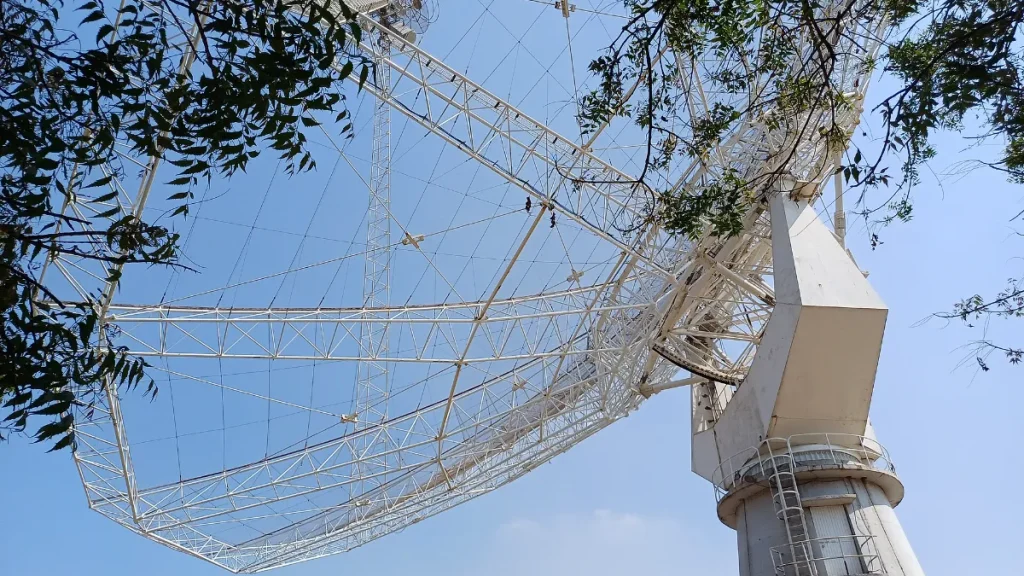
Photo: DesiBoy101 / CC BY 4.0, via Wikimedia Commons
Pune, 30th October 2026: Astronomers from Pune have found a giant radio galaxy whose central black hole has switched its jets on and off four separate times. It is the first known example of a galaxy with four distinct episodes of jet activity.
The study was led by Pavan Vijay Khadekar, a PhD student, under Prof Dharam Vir Lal of the National Centre for Radio Astrophysics (NCRA-TIFR) and Prof Ramana Athreya of IISER Pune. It has been published in The Astrophysical Journal.
What the team found
Radio galaxies shoot out jets of charged particles from the supermassive black holes at their centres. These jets can stretch across huge distances and glow in radio waves. Sometimes a black hole goes quiet and then starts again, leaving older, fading lobes behind newer ones.
Until now, only six radio galaxies were known to show three such episodes. This one shows four. The team estimates that the first episode ended about 21 million years ago, while the current, fourth episode began a few million years ago. The galaxy’s overall shape looks like the letter S.
How GMRT helped
Most of the high-quality data came from the Giant Metrewave Radio Telescope (GMRT) at Khodad near Narayangaon, about 80 km north of Pune. The team also used archived data from the Very Large Array in the United States and MeerKAT in South Africa.
By layering images at several radio frequencies, the researchers could separate older and younger lobes, since older plasma looks different at low frequencies. GMRT’s strength at low frequencies is what made this possible.
Prof Divya Oberoi of NCRA-TIFR, who was not part of the study, commented on the work. The team has also suggested a method that could help find more such “restarted” radio galaxies, possibly with even more cycles of activity.
Why it matters
Black holes do not feed all the time. Galaxies like this one act as a record of when the black hole was active and when it rested, which helps scientists understand how galaxies and their black holes grow together.
It is also a reminder that some of the world’s leading radio astronomy happens just a couple of hours from Pune. NCRA usually opens GMRT to the public on National Science Day in February.
If you like sky news, read about the Leonid meteor shower from Pune and the ISRO NVS-03 launch.
Frequently Asked Questions
Who discovered the radio galaxy with four jet episodes?
A team led by PhD student Pavan Vijay Khadekar with Prof Dharam Vir Lal of NCRA-TIFR and Prof Ramana Athreya of IISER Pune.
Which telescope was used?
Mainly the Giant Metrewave Radio Telescope (GMRT) near Narayangaon, along with archival data from the VLA and MeerKAT.
Where was the study published?
In The Astrophysical Journal.
Where is GMRT located?
At Khodad near Narayangaon in Pune district, about 80 km north of Pune.