How Does Pune Metro Line 3 Run Without Overhead Wires? The 750-Volt Third Rail Explained
Pune Metro Line 3 has no overhead wires. Its trains draw 750-volt DC power from a third rail through collector shoes. Here is how the system works.
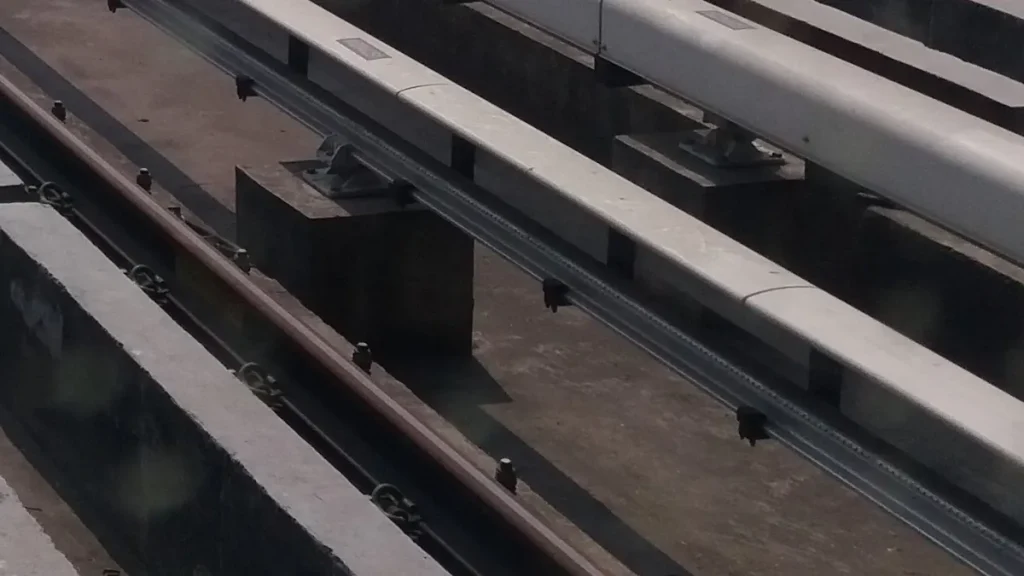
Photo: Tarunsamanta / CC BY-SA 4.0, via Wikimedia Commons
Last updated: 17 November 2026
Pune Metro Line 3, the Pink Line from Maan in Hinjewadi to District Court, has no wires hanging above the tracks. Its trains take power from a third rail laid alongside the running rails, which carries a continuous 750-volt direct current supply.
That makes Line 3 the first metro corridor in Maharashtra to use this system, according to PuneNow.
How the third rail powers the train
A metro train needs a steady electric supply to run its motors, air conditioning and lights. On Line 3, that supply comes from below, not above:
- A third steel rail, called the live rail, runs along the track on insulators.
- Each coach has metal “collector shoes” fitted underneath.
- As the train moves, the shoes slide along the live rail and pick up the 750-volt DC current.
- The current returns through the running rails to complete the circuit.
The live rail has a non-conductive protective cover on top, and the steel conductor sits on weather-resistant insulators so that power does not leak into the structure.
Why Line 3 uses a third rail
The Free Press Journal listed the reasons given for the choice:
- A compact design that needs less space on the viaduct
- Lower maintenance than overhead wiring
- Good support for frequent services
- Less visual clutter along the corridor
- Fewer disruptions, since there are no wires to snap in wind or be hit by kites and branches
The last point matters on a fully elevated 23 km line that runs over busy roads like University Road and Baner Road.
How it differs from the Purple and Aqua lines
If you ride Maha Metro’s Purple Line (PCMC to Swargate) or Aqua Line (Vanaz to Ramwadi), you will notice wires running above the track, held up by poles. Those lines use overhead catenary, where a pantograph on the train roof touches the wire.
On Line 3, look at the roof of the train and you will not see a pantograph. Look at the track from the platform and you will see the covered third rail on one side.
Line 3 also uses Communications-Based Train Control (CBTC) signalling, which tracks every train’s location and speed continuously, allowing trains to run closer together safely.
Is the third rail safe for passengers
The live rail is on the track, and passengers never need to be on the track. Platforms on Line 3 are elevated and separated from the track. The rule for passengers is simple: never step or reach onto the track or drop down to pick up a fallen item. Ask station staff for help instead.
The protective cover on the rail reduces the risk of accidental contact, but 750 volts is dangerous. Maintenance staff work on the track only when power is switched off.
Where else in India third rail metros run
Third rail systems are common in metros worldwide, and some Indian metros use them as well. In Pune, it is a first. If you want to know fares, timings and station names before your first ride, read our Line 3 stations, fares and timings guide and the Pune Metro timings and fares hub.
Frequently asked questions
What voltage does Pune Metro Line 3 use?
Line 3 uses a 750-volt direct current third rail system.
Why are there no overhead wires on the Hinjewadi metro?
Trains on Line 3 draw power from a third rail beside the track through collector shoes under each coach, so overhead wires are not needed.
Is the third rail dangerous?
Yes, it carries high voltage, which is why passengers must never go onto the track. The rail has a protective cover and sits on insulators.
Do other Pune Metro lines use a third rail?
No. The Purple and Aqua lines run by Maha Metro use overhead wires. Line 3 is the first in Maharashtra with a third rail.