Aga Khan Palace Pune Guide: Gandhi’s 1942 Prison, Kasturba’s Samadhi, Timings, Ticket Price and How to Reach
Aga Khan Palace in Pune is where Mahatma Gandhi was held during Quit India. A guide to its history, samadhis, museum, timings and ticket price.
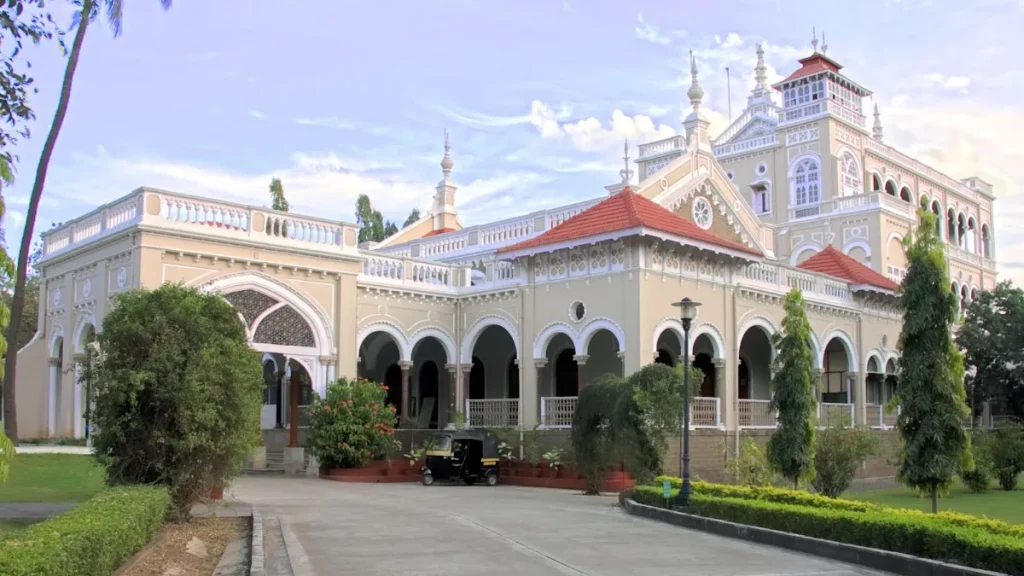
Photo: Khushroo Cooper / CC BY-SA 2.0, via Wikimedia Commons
Last updated: 19 November 2026
The Aga Khan Palace on Nagar Road is one of Pune’s most important landmarks of the freedom struggle. Mahatma Gandhi, Kasturba Gandhi and Gandhi’s secretary Mahadev Desai were held prisoner here during the Quit India Movement, and both Kasturba and Mahadev Desai died within its walls.
Quick facts
- Built: 1892, by Sultan Muhammed Shah Aga Khan III
- Area: about 19 acres, most of it garden
- Gandhi’s internment: August 9, 1942 to May 6, 1944
- Status: Monument of national importance, protected by the Archaeological Survey of India since 2003
- Managed by: Gandhi National Memorial Society
History of the palace
Aga Khan III, the spiritual leader of the Nizari Ismaili Muslims, built the palace in 1892 partly as a relief measure, to give work to people hit by famine in the surrounding villages, according to Wikipedia’s history of the site.
Construction took about five years and cost about ₹12 lakh at the time. The building is in Indo-Saracenic style, with wide corridors and Italian-style arches.
After Gandhi gave the “Quit India” call in August 1942, the British arrested him and held him here with Kasturba, Mahadev Desai and others. Mahadev Desai died in the palace within days of arrival in August 1942. Kasturba Gandhi died here in February 1944. Gandhi was released in May 1944.
In 1969, Aga Khan IV donated the palace to the people of India as a tribute to Gandhi.
What to see inside
The main building is now a museum. According to Incredible India, you can see:
- The room where Gandhi and Kasturba were confined
- Gandhi’s personal items, including a charkha (spinning wheel), letters and sandals
- Photographs and paintings from the freedom movement
- The samadhis of Kasturba Gandhi and Mahadev Desai in the garden
- A memorial where part of Gandhi’s ashes were placed in 1992
The large lawns are good for a quiet walk. Keep your voice low near the samadhis.
Timings and ticket price
According to Native Planet, the palace is open from 9 am to 5.30 pm, and entry costs ₹5 for Indian visitors, ₹2 for children and ₹100 for foreign nationals.
Fees for ASI monuments are revised from time to time, so check at the ticket counter or on the ASI website before you go. Photography is generally allowed in the gardens, with restrictions inside some galleries.
How to reach Aga Khan Palace
The palace is on Pune-Nagar Road near Kalyani Nagar and Yerawada, about 7 km from Pune Railway Station and about 4 km from Pune Airport. Autos and cabs are the easiest option. PMPML buses on Nagar Road stop nearby. Read our Pune airport guide if you are visiting on the way to a flight.
Best time to visit
Weekday mornings are quietest. Winter, from November to February, is pleasant for walking the gardens. Gandhi Jayanti on October 2 and Martyrs’ Day on January 30 usually see special programmes and larger crowds.
Combine it with
You can pair the visit with other city heritage sites. See our museums in Pune guide and Shaniwar Wada guide.
Frequently asked questions
Why is Aga Khan Palace famous?
Mahatma Gandhi, Kasturba Gandhi and Mahadev Desai were imprisoned there from 1942 to 1944 during the Quit India Movement, and the samadhis of Kasturba and Desai are in its grounds.
What is the entry fee for Aga Khan Palace?
Travel listings put it at ₹5 for Indians, ₹2 for children and ₹100 for foreigners. Check at the counter, as ASI fees can change.
What are Aga Khan Palace timings?
It is open from about 9 am to 5.30 pm, according to travel listings.
Who built Aga Khan Palace?
Sultan Muhammed Shah Aga Khan III built it in 1892.