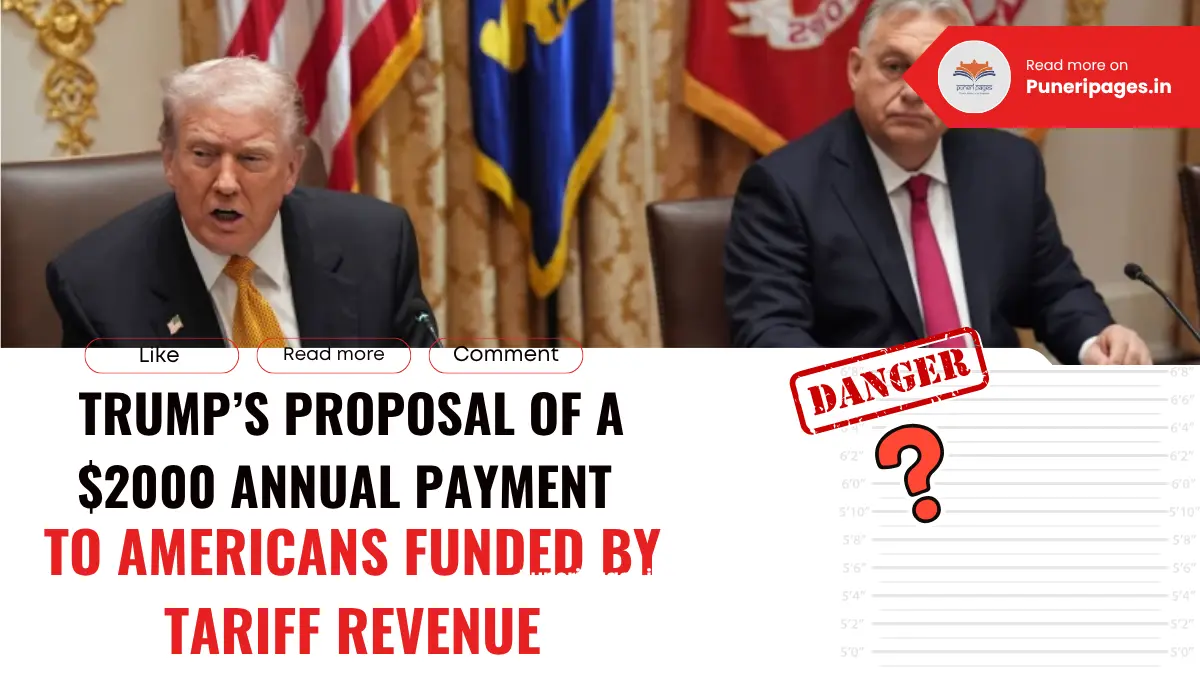
Trump’s proposed $2,000 tariff-funded payment aims to provide annual financial support to American households by using revenue collected from imported goods.
By Prashant for PuneriPages.in
Former U.S. President Donald Trump has introduced a proposal to provide $2,000 annually to every American household, funded through tariff revenue generated from foreign imports. This initiative has sparked national and global attention due to its economic implications, proposed funding mechanism, and potential impact on international trade relations. In this extensive analysis, we examine the structure of the proposal, how tariffs work, who ultimately pays for them, and what the potential outcomes may be for American consumers, industries, and global trade.
Table of Contents
Understanding the Tariff-Funded Income Proposal
The core idea behind this proposal is straightforward: increase tariffs on imported goods and use the revenue collected from those tariffs to redistribute funds directly to American households. According to the plan, qualified individuals or households would receive up to $2,000 annually, framed as a “universal patriotic dividend.”
This approach positions tariffs not only as a trade policy tool but also as a revenue redistribution mechanism aimed at delivering direct financial relief to the American public.
How Tariffs Generate Revenue
What Are Tariffs?
Tariffs are taxes imposed by a government on goods or products imported from other countries. When foreign companies sell products to U.S. markets, they must pay a tariff fee at the border.
Who Actually Pays the Tariff?
Although tariffs are imposed on foreign exporters, the cost often passes directly to American companies and ultimately to consumers. This happens because:
- Importers pay the tariff on purchased goods.
- Importers raise prices to maintain profit margins.
- Consumers pay more in stores.
This means tariff-funded programs can be indirectly paid for by U.S. consumers, depending on how markets adjust.
Projected Revenue and Feasibility
Economists estimate that large-scale tariffs on consumer products, industrial materials, technology components, and automotive imports could generate hundreds of billions of dollars annually. Whether this would cover universal $2,000 payments depends on:
| Category | Estimated Annual Tariff Revenue |
|---|---|
| Current Tariffs (Existing) | ~$75 Billion |
| Proposed New Broad Tariffs | $200–$300+ Billion (Depending on rate increase) |
With approximately 130–135 million U.S. households, a yearly payment of $2,000 each requires $260–$270 billion annually.
Thus, for this proposal to function, the U.S. would need to:
- Expand the tariff base (tax more imports)
- Increase tariff rates significantly
- Manage possible trade retaliation from global partners
Potential Economic Benefits
1. Direct Household Relief
A yearly cash transfer helps support lower- and middle-income families, particularly during inflationary periods.
2. Encouragement for Domestic Manufacturing
Higher tariffs may incentivize:
- Domestic production
- Reshoring of supply chains
- Expansion of American industrial jobs
3. Increased Economic Circulation
Direct payments increase consumer spending, supporting:
- Local businesses
- Service sectors
- Employment growth
Challenges, Risks, and Trade Implications
1. Increase in Consumer Prices
If companies raise prices in response to tariffs, everyday goods could become more expensive, reducing the real value of the $2,000 benefit.
2. Strain on International Trade Relations
Major trading partners such as:
- China
- Mexico
- The European Union
may respond with retaliatory tariffs, making U.S. exports less competitive abroad.
3. Impact on U.S. Manufacturers Depending on Imported Materials
Industries like:
- Automotive manufacturing
- Electronics assembly
- Pharmaceuticals
rely on imported components; higher tariff costs could disrupt production efficiency and profitability.
Historical Context of Tariff-Based Economic Strategies
The United States has used protectionist tariff policies multiple times:
| Period | Tariff Objective | Result |
|---|---|---|
| 1930s (Smoot-Hawley) | Protect U.S. manufacturing | Triggered global retaliations |
| 2018–2020 | Pressure China on trade practices | Increased consumer prices, reshored some supply chains |
These historical patterns show that tariffs can be powerful, but their outcomes vary depending on:
- Scale
- Duration
- International response
- Domestic production capacity
What Americans Should Understand Moving Forward
Whether or not one supports this proposal, it represents a significant shift in how tariff revenue is imagined. Instead of tariffs simply shielding domestic industries, this model proposes converting revenue into universal direct financial benefits.
To evaluate the proposal effectively, key considerations include:
- Will domestic manufacturing scale fast enough to absorb demand shifts?
- Will consumer price increases offset payments?
- How will global trade partners react?
The debate will continue to evolve, but it is clear that the proposal highlights a growing emphasis on economic nationalism and household-level financial relief strategies.
About The Author