Pune Collector calls IIT Delhi team for a scientific review of the Navale Bridge stretch, focusing on road design, slope analysis, and long-term safety solutions — via Puneripages.in
By Prashant for PuneriPages.in
In a crucial step toward improving road safety and addressing recurring accidents along one of Pune’s most dangerous road corridors, Pune District Collector Jitendra Dudi has invited a team of experts from IIT Delhi to conduct a scientific review of the Navale Bridge stretch on the Pune–Bengaluru Highway. The decision follows a recent series of fatal mishaps that have highlighted the urgent need for structural and traffic management reforms on this accident-prone section.
The move signals a shift toward evidence-based infrastructure evaluation, combining engineering expertise, advanced data analysis, and on-ground assessment to propose long-term solutions for one of the city’s most challenging traffic zones.
Table of Contents
Background – The Navale Bridge Accident Hotspot
The Navale Bridge stretch, located near Narhe on the Pune–Bengaluru bypass, has gained notoriety as a high-risk accident zone over the past few years. Despite the implementation of multiple remedial measures such as speed restrictions, rumble strips, barricades, and warning signage, accidents have continued unabated.
Recent investigations reveal that the combination of steep gradients, high-speed descents, inadequate signage visibility, and heavy truck movement contributes to frequent collisions—often involving multiple vehicles.
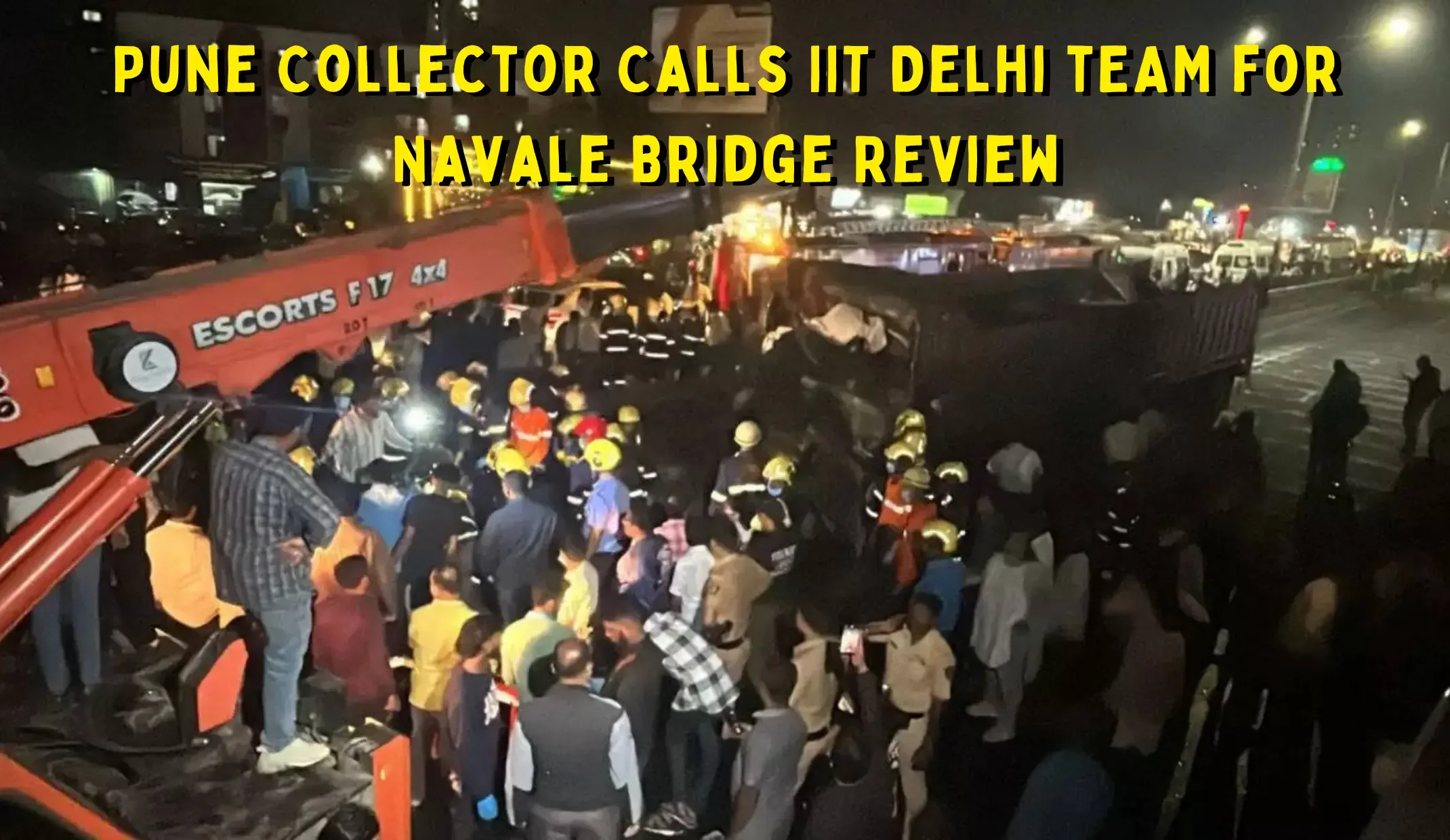
In the latest incident earlier this month, a trailer truck reportedly lost control while descending from the Katraj tunnel toward Navale Bridge, crashing into several vehicles. The collision resulted in casualties and reignited public outrage over the government’s inability to permanently resolve the issue.
IIT Delhi to Lead Scientific and Structural Assessment
The Pune district administration has sought assistance from IIT Delhi’s Civil Engineering and Road Safety Department—one of the premier institutions in India specializing in traffic engineering, accident analysis, and infrastructure optimization.
The IIT Delhi team will conduct a scientific audit of the Navale Bridge stretch, focusing on both design and operational flaws. Their review will include:
- Geometric and Gradient Assessment: Analysis of the slope, curvature, and structural layout to determine whether the existing design meets national safety standards.
- Traffic Load Study: Evaluating traffic density patterns, especially heavy vehicle movement, during peak and off-peak hours.
- Speed and Braking Dynamics: Studying the braking efficiency of large vehicles on the downhill slope and identifying points of potential brake failure or skid zones.
- Signage and Visibility Audit: Reviewing the placement, size, and effectiveness of traffic signage, lighting, and lane markings.
- Drainage and Surface Quality: Examining how rainwater accumulation and road wear impact vehicle control and accident rates.
The findings of this review will be submitted as a technical report to the district administration and the National Highways Authority of India (NHAI) for implementation.
Collector’s Statement and Road Safety Priorities
Collector Jitendra Dudi emphasized that the review will ensure scientific validation of all previous remedial measures and introduce engineering-driven solutions instead of temporary fixes.
“We have reached out to IIT Delhi to conduct a detailed scientific study of the Navale Bridge corridor. The aim is to identify the root causes of accidents and recommend permanent corrective measures that can make this route truly safe for all commuters,” said Dudi.
He also mentioned that the administration will coordinate closely with NHAI, PMC, and the traffic police to ensure seamless execution of the IIT team’s recommendations once the review is complete.
Ongoing Remedial Measures at the Site
While the review is underway, authorities have initiated several short-term interventions to minimize risks for daily commuters. These include:
- Speed Regulation: The maximum speed limit has been capped at 40 km/h for heavy vehicles along the descent from the Katraj tunnel to Navale Bridge.
- Dedicated Police Deployment: Traffic police have been stationed round-the-clock to monitor speeding and reckless driving.
- Emergency Response Station: An emergency control room and towing unit have been set up near the bridge to provide rapid assistance during accidents.
- Check-Post for Heavy Vehicles: A special inspection point for trucks has been established to ensure that vehicles entering Pune city are roadworthy and not overloaded.
- Enhanced Lighting and Signage: The Pune Municipal Corporation (PMC) has installed additional streetlights and high-visibility reflective signs to improve nighttime visibility.
Despite these steps, officials acknowledge that structural design flaws remain the primary issue, necessitating a deeper technical investigation.
Expert Insights – Engineering the Solution
Road safety experts believe that the Navale Bridge issue is not just an enforcement problem but a design failure. The downhill gradient, combined with poor merging lane design and insufficient braking zones, creates a “perfect storm” for high-impact collisions.
Civil engineers from IIT Bombay and Pune’s College of Engineering have previously suggested solutions such as:
- Gradient Reduction via Road Realignment: Slightly re-engineering the slope to reduce acceleration pressure on heavy vehicles.
- Dedicated Truck Lane: Creating a segregated lane for heavy vehicles with extended braking areas.
- Friction-Enhanced Pavement: Applying special surface coating to improve tire grip during downhill motion.
- Automatic Speed Detection Systems: Installing AI-based cameras that detect speeding and alert enforcement units in real time.
The IIT Delhi study is expected to incorporate such engineering innovations backed by simulation models and field testing.
Why IIT Delhi Was Chosen
Among several engineering institutions in India, IIT Delhi stands out for its expertise in transportation infrastructure analysis and accident reconstruction. The institute has previously assisted state governments in redesigning high-risk corridors and improving national highway geometries under the Ministry of Road Transport and Highways.
Their involvement ensures that Pune’s assessment will follow global safety standards, using advanced data tools such as LiDAR scanning, GPS mapping, and traffic simulation software to deliver actionable insights.
Local Impact – Residents and Commuters React
Residents of Narhe, Ambegaon, and Vadgaon—areas surrounding Navale Bridge—have welcomed the decision but remain cautiously optimistic. Many locals have long demanded permanent structural changes rather than repeated cosmetic interventions.
One resident stated,
“Every few months, we hear promises of improvements, but the accidents keep happening. If IIT Delhi’s review brings real changes, it could finally save lives.”
Commuters who use the highway daily expressed relief that the matter is now being taken seriously at a scientific and administrative level.
Data That Demands Change
According to official statistics, over 150 accidents have occurred on this stretch in the past three years, resulting in dozens of fatalities and hundreds of injuries. Despite multiple safety drives, the rate of incidents has not significantly declined, underscoring the need for a data-backed structural solution rather than ad-hoc measures.
Future Outlook – Engineering Safer Roads
Once the IIT Delhi report is submitted, authorities plan to immediately prioritize the most critical interventions. The district administration will also request central government funding under the National Road Safety Programme to implement long-term upgrades.
Additionally, Pune’s urban planning bodies are considering realigning the bypass and introducing smart traffic management systems powered by AI to prevent future disasters.
A Scientific Step Toward Safer Highways
The decision to involve IIT Delhi for a scientific review of the Navale Bridge stretch marks a turning point in Pune’s road safety efforts. It moves the narrative away from blame and bureaucracy toward data, engineering, and accountability.
If implemented effectively, this collaboration could set a precedent for similar reviews across other high-risk corridors in Maharashtra and beyond — turning Pune’s tragic accident zone into a model for smart, safe infrastructure planning.
About The Author