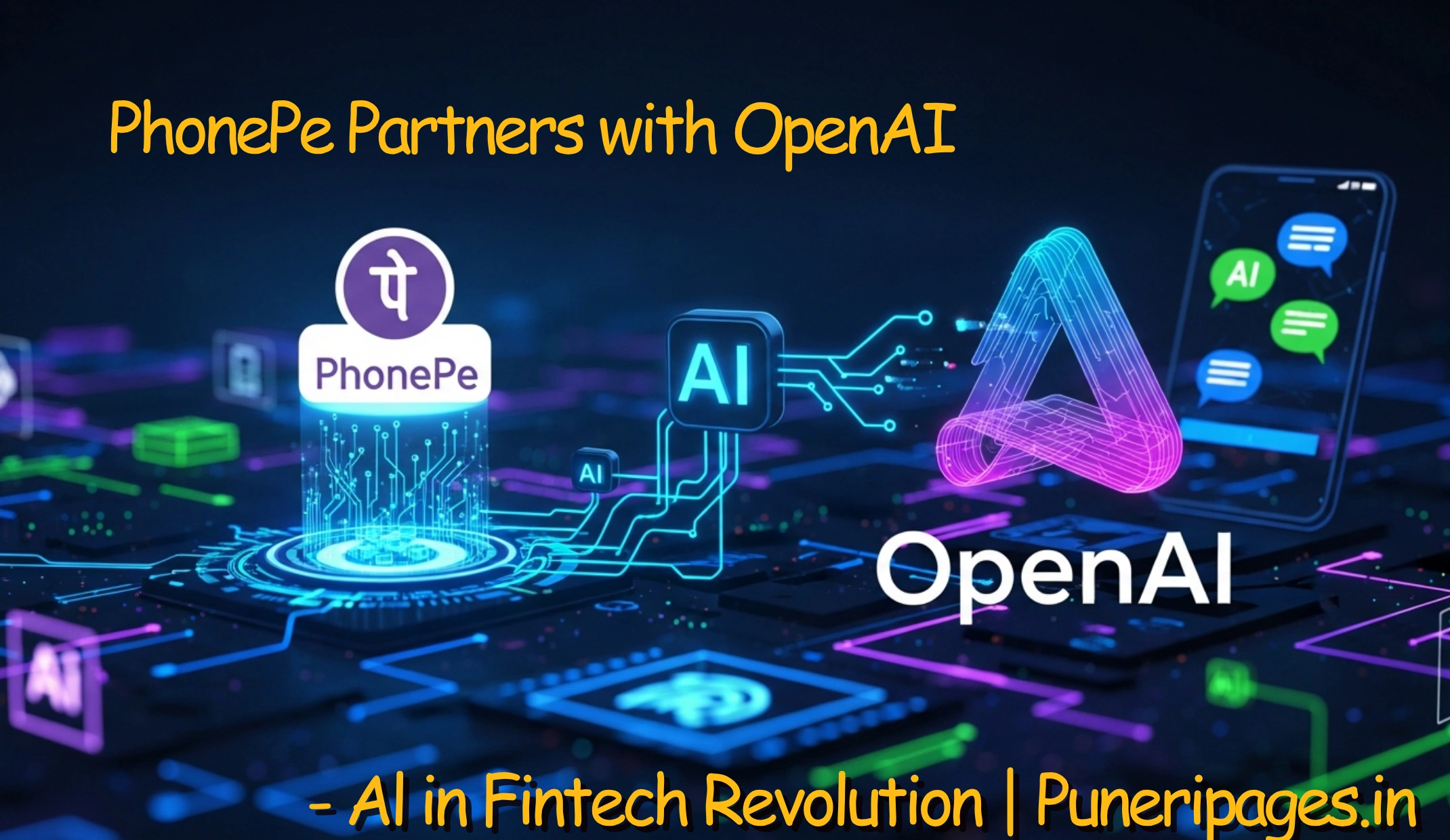
PhonePe and OpenAI unite to revolutionize India’s fintech sector with AI-powered innovation.
By Prashant for PuneriPages.in
We are witnessing a landmark collaboration in India’s fintech and technology ecosystem: PhonePe has partnered with OpenAI to integrate generative-AI tools directly into its payment and merchant apps. This move marks a bold step for both companies and opens up a new era of user-friendly, AI-powered features in everyday finance.
Table of Contents
Strategic Collaboration Overview
In its official press release, PhonePe announced the strategic collaboration with OpenAI, stating that it aims to bring ChatGPT’s features to its broad user base across India. Under this alliance:
- ChatGPT will become discoverable within the PhonePe consumer app and the “PhonePe for Business” app.
- The rollout will also leverage the broader PhonePe ecosystem — including the Indus Appstore — to amplify reach and accessibility.
- OpenAI views this as a “significant milestone” in its mission to expand consumer-AI in India.
This alignment signals that PhonePe is moving beyond payments into AI-driven services, while OpenAI taps India’s large digital user base for generative-AI deployment.
What Users Will Experience
The integration of ChatGPT into PhonePe is designed to cater to a range of everyday user needs within the payments & finance domain. Some immediate features include:
- Smart conversational assistance for tasks like travel planning, product or service comparisons, shopping suggestions and general queries.
- Business owner tools in the Merchant/Business version of PhonePe: such as GST filing guidance, business growth tips, content generation, and customer-engagement assistance.
- Discovery and context-aware insights — the AI system draws on user-specific context, payment history and behavioural data (within privacy norms) to offer more tailored suggestions. While full details are yet to be published, this is implied in statements about “population-scale digital services”.
From a consumer perspective, the experience is elevated: beyond tapping icons for payments, users will now converse with a helper that understands context, intent and offers value-added insights.
Implications for Fintech and AI Ecosystem
This partnership has several far-reaching implications for both the fintech and artificial intelligence sectors in India:
- Generative AI moves into mainstream consumer tech – Unlike standalone chatbots, this will embed ChatGPT into a mass-market app with over 600 million registered users.
- Payments + AI = new service frontier – The merger of payment rails with conversational assistance unlocks new monetisation paths: e-commerce suggestions, financial planning, merchant services, personalised offers.
- Competitive pressure on other fintechs – With PhonePe raising the bar, rivals will need to integrate smarter AI tools, including fraud-detection intelligence, voice-assist layers and conversational UI.
- Data & infrastructure implications – Leveraging generative AI at scale will demand strong data governance, privacy safeguards and scalable compute infrastructure. OpenAI’s involvement signals a focus on robustness and ethics.
In effect, this collaboration moves India’s digital payments landscape toward a hybrid model: payments + conversations + intelligence.
Technical & Implementation Considerations
While the announcement creates excitement, the actual rollout will involve several technical layers:
- Integration of ChatGPT API within PhonePe’s apps, ensuring smooth UI/UX transitions and performance at scale.
- Ensuring privacy and compliance: user-data must be handled with India’s regulatory context in mind, including payment data, personal information and AI outputs.
- Infrastructure scaling: serving conversational interactions across millions of users requires back-end compute, caching, resiliency and fault-tolerance.
- Localisation and language support: India’s multilingual user base implies the AI needs to support Hindi, Marathi, Tamil, Telugu and other regional languages — a non-trivial challenge.
- Ecosystem expansion: The tie-in with Indus Appstore suggests that AI features may extend beyond PhonePe into wider apps and services.
These factors determine how quickly and how reliably the integration will deliver impact.
What Consumers & Merchants Should Know
For consumers:
- Expect access to smarter help inside PhonePe for everyday queries: e.g., “Find me flights to Goa under ₹10,000”, “Compare mobile data plans”, “Generate a grocery list under ₹2,000”.
- Feature availability may roll out gradually across regions and users — early testers may get access first.
- Use it with awareness: while AI helps, verify critical advice (especially financial or legal) independently.
For merchants/business owners on PhonePe:
- New AI-driven toolsets may help with onboarding, business advice, content creation and customer engagement.
- It becomes more important to ensure your profile and data on PhonePe are complete: title, category, reviews — because AI may surface merchant-specific suggestions from your listing.
- Be aware of increased competition: with smarter tools for consumers, merchant discovery and engagement might become more dynamic.
Challenges & Risks to Monitor
While promising, the PhonePe-OpenAI integration comes with potential risks and challenges:
- Data privacy: Sensitive payment and financial data must not be exposed inappropriately through AI responses.
- Bias & accuracy: AI suggestions must be accurate and free of harmful bias — especially when guiding purchases or merchant-selection.
- Infrastructure reliability: High concurrency and latency could impact user experience if not handled properly.
- Regulatory oversight: The intersection of finance and AI may invite scrutiny from RBI, NPCI, and other regulators regarding advice, automation and liability.
- User trust: Users must trust the AI recommendations; any significant misstep may erode confidence in both AI and the PhonePe brand.
These factors will shape how fast such integrations succeed and scale.
Looking Ahead: Potential Use-Cases & Roadmap
Beyond the initial features, we can foresee advanced scenarios enabled by this collaboration:
- Personal finance advisor: ChatGPT-powered modules that evaluate spending patterns, suggest budgets, track investments and alert risk.
- Merchant growth assistant: For business users, AI may analyse sales trends, recommend local promotions, generate customised marketing messages or segment customers.
- Multimodal interactions: Using voice, images, chat inside PhonePe — e.g., take a photo of a product and ask for price comparison and payment options.
- Seamless voice payments: Conversational interfaces where users say “Pay my electricity bill ₹2,500”, and the app confirms and completes the transaction.
- Hyper-local offers generation: AI analyses user location, preferences and transaction habits to deliver real-time local store offers or micro-loans.
These advances would further blur the line between payments provider and intelligent platform.
Conclusion
The partnership between PhonePe and OpenAI marks a significant milestone in India’s fintech deployment of generative AI. By embedding ChatGPT into both consumer and merchant apps, PhonePe is redefining user engagement, service intelligence and platform depth. For users and merchants alike, this means smarter interactions, better insights, and new capabilities rooted in everyday finance and commerce. As this integration rolls out, it will be crucial to monitor how effectively it delivers and the safeguards that govern its use.
Stay tuned for full feature availability, user roll-out schedules and deeper insight into how this will reshape digital payments in India.
About The Author