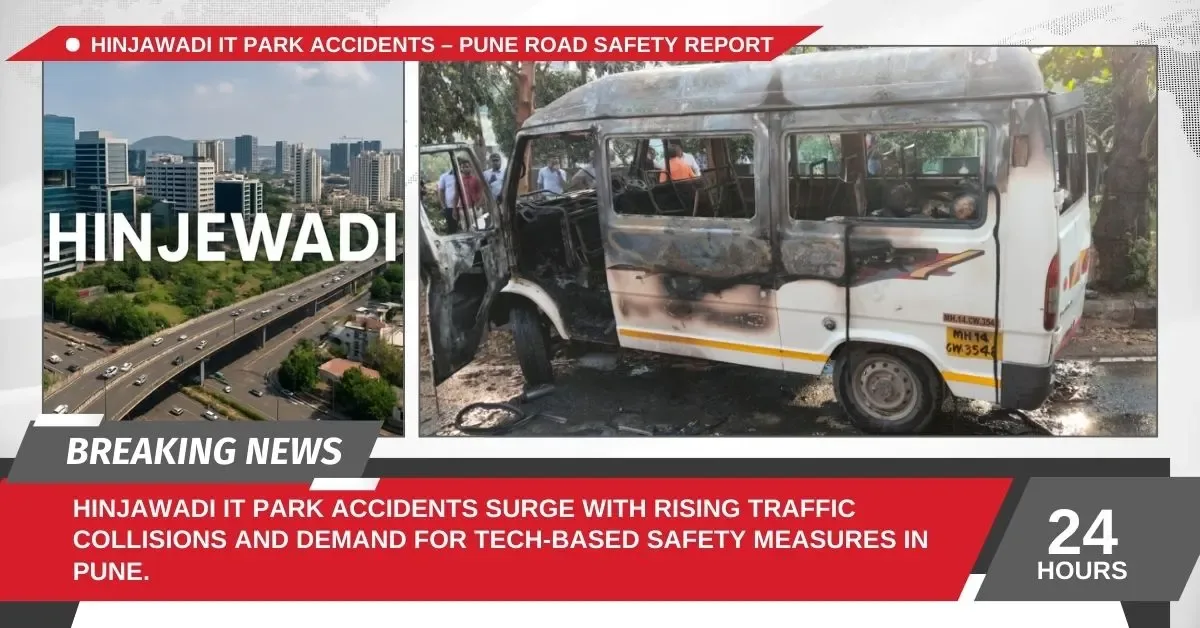
Hinjawadi IT Park is witnessing a worrying rise in road accidents, pushing IT employees to demand smart, technology-driven safety solutions.
By Prashant for PuneriPages.in
Pune’s Hinjawadi IT Park — one of India’s largest tech corridors and home to over 300,000 IT professionals — is facing an alarming surge in fatal road accidents. The rapid rise in accidents across Phase 1, Phase 2 and Phase 3 has sparked a wave of concern among employees, tech companies, and civic authorities. As traffic density grows and road discipline deteriorates, IT workers are now demanding technology-driven safety interventions, stricter enforcement, and better urban mobility planning to safeguard thousands of daily commuters.
Table of Contents
Hinjawadi’s Accident Spike: A Troubling Pattern Emerges
Over the past year, Hinjawadi has recorded a significant uptick in fatal and near-fatal crashes, particularly involving two-wheelers — the primary mode of transport for most IT employees. Traffic police data suggests that accidents have intensified during peak office hours, late-night project shifts, and early-morning commutes.
Why Hinjawadi Is Becoming a High-Risk Zone
Several factors contribute to this spike:
- Massive traffic congestion due to rapid IT expansion
- Unregulated speeding zones and unsafe overtaking on wide internal roads
- Lack of pedestrian crossings in high-footfall stretches
- Heavy vehicular movement from ongoing construction projects
- Poor lane discipline during peak entry and exit times
- Inadequate street lighting in certain stretches of Phase 2 and Phase 3
- Rise in e-bike and gig delivery vehicles around food and hostel clusters
As a result, even short-distance commutes have turned into dangerous journeys for thousands of young professionals.
Employee Voices Grow Louder: “We Need Technology, Not Just Warnings”
The IT workforce in Hinjawadi — known for its tech-savvy, solutions-driven mindset — is now demanding smart, sustainable and technology-backed interventions from authorities.
Employees argue that traditional measures like traffic marshals and signage are no longer sufficient. Instead, they want:
1. AI-Powered Speed Monitoring
Automated systems that can detect overspeeding and instantly issue digital challans.
2. Smart Traffic Signals
Adaptive signals that adjust based on vehicle density to reduce chaotic merging and bottlenecks.
3. Facial-Recognition Enabled Enforcement
To identify repeat offenders riding without helmets, triple-seat riders, and signal jumpers.
4. GPS-Integrated Bus Tracking
To ensure safer, punctual corporate bus operations that reduce dependency on two-wheelers.
5. High-Luminosity LED Streetlights
For clearer visibility during night shifts — especially for women employees.
Companies Step In: CSR-Backed Safety Solutions Proposed
Several major IT firms located in Hinjawadi — including those in Rajiv Gandhi Infotech Park — are pressing for collective action.
Corporate demands include:
- Building AI-driven monitoring towers at junctions
- Improved emergency response time inside the tech park
- Dedicated cycle lanes and pedestrian belts
- A centralized “Hinjawadi mobility dashboard” for live traffic updates
- CSR-funded ambulance stations near Phase 1 & Phase 3
Many companies believe that safer commuting will improve employee well-being, retention, and productivity.
Tech-Park Infrastructure: Growing but Lagging Safety Needs
While Hinjawadi continues to expand horizontally, its safety infrastructure hasn’t kept pace.
Key weak spots identified by urban planners:
- Narrow exit lanes merging into the highway
- Chaotic intersections near Wipro Circle, Infosys Circle and Quadron
- Low visibility turns near Phase 3 commercial complexes
- Insufficient zebra crossings despite high foot traffic
- Encroached footpaths forcing pedestrians onto the main road
In a campus hosting giants like Infosys, TCS, Cognizant, Capgemini, Persistent, Tech Mahindra, and dozens more — the lack of safe commuting infrastructure is raising pressing concerns.
Police Response: Crackdowns and Tech Trials Begin
The Pimpri-Chinchwad police have acknowledged the issue and begun implementing new measures.
Recent steps include:
- Helmet checks at entry points
- Night patrol units placed at accident hotspots
- Crackdown on triple-seat riders and rash drivers
- Pilot installation of ANPR cameras (Automatic Number Plate Recognition)
- Plans for AI-based violation detection
- Coordination with MIDC and HIA (Hinjawadi Industries Association) for road repairs
But employees argue that enforcement should be continuous, not seasonal.
Data Don’t Lie: Why Urgency Is Rising
Internal police statistics highlight alarming trends:
- Majority of victims are 18–35-year-old IT employees
- 70% of fatal crashes involve two-wheelers
- Most accidents occur between 6:30–10:00 AM and 9:00 PM–12:00 AM
- Overspeeding and sudden lane cutting are top causes
- Accident density is highest in Phase 1–Wipro Circle stretch
This data underscores the need for a tech-led safety ecosystem, not just reactive policing.
Employee Safety Suggestions Gain Traction
Online forums, LinkedIn discussions, Telegram groups and Reddit threads linked to Hinjawadi employees list numerous suggestions:
Most-popular employee-backed proposals:
- Digital helmets with RFID to verify riders entering IT campus
- Geo-fenced slow zones with automatic speed reduction alerts
- Drowsiness detection systems in corporate cabs
- Dedicated “shift-end lanes” for safe dispersal during late-night shift changes
- Multi-level parking to reduce roadside congestion
- App-based walk-safe routes for women employees
Employees believe these measures can drastically reduce avoidable tragedies.
Is Metro Line 3 the Long-Term Safety Answer?
The upcoming Hinjawadi–Shivajinagar Metro Line 3 is expected to significantly reduce two-wheeler dependency.
Projected impact once fully operational:
- 30–40% drop in private vehicle use
- Reduced congestion at all major junctions
- Lower accident risk due to fewer bikes
- Improved travel speed and predictability
However, with completion still anticipated in phases, immediate solutions are urgently needed.
What Authorities Must Prioritise Next
Based on current trends and expert recommendations, authorities must focus on:
Short-term priorities
- Install AI monitoring towers
- Repair potholes and widen narrow stretches
- Increase street lighting
- Deploy dedicated traffic marshals at 5 major junctions
Medium-term priorities
- Redesign dangerous intersections
- Create exclusive cycling and pedestrian lanes
- Establish 24×7 EMS units inside the tech park
Long-term priorities
- Expand metro connectivity
- Introduce electric shuttle buses
- Build integrated mobility hubs across phases
Conclusion
Hinjawadi IT Park — the pride of Pune’s technological growth — is now grappling with preventable road tragedies. The alarming surge in fatal accidents highlights an urgent need for smart, scalable and technology-driven safety measures. As IT employees raise their voices and companies collaborate with authorities, it is clear that Pune must adopt a future-ready mobility strategy that protects its workforce.
A thriving tech hub must also be a safe one. Hinjawadi’s next chapter must prioritise its people as much as its progress.
About The Author