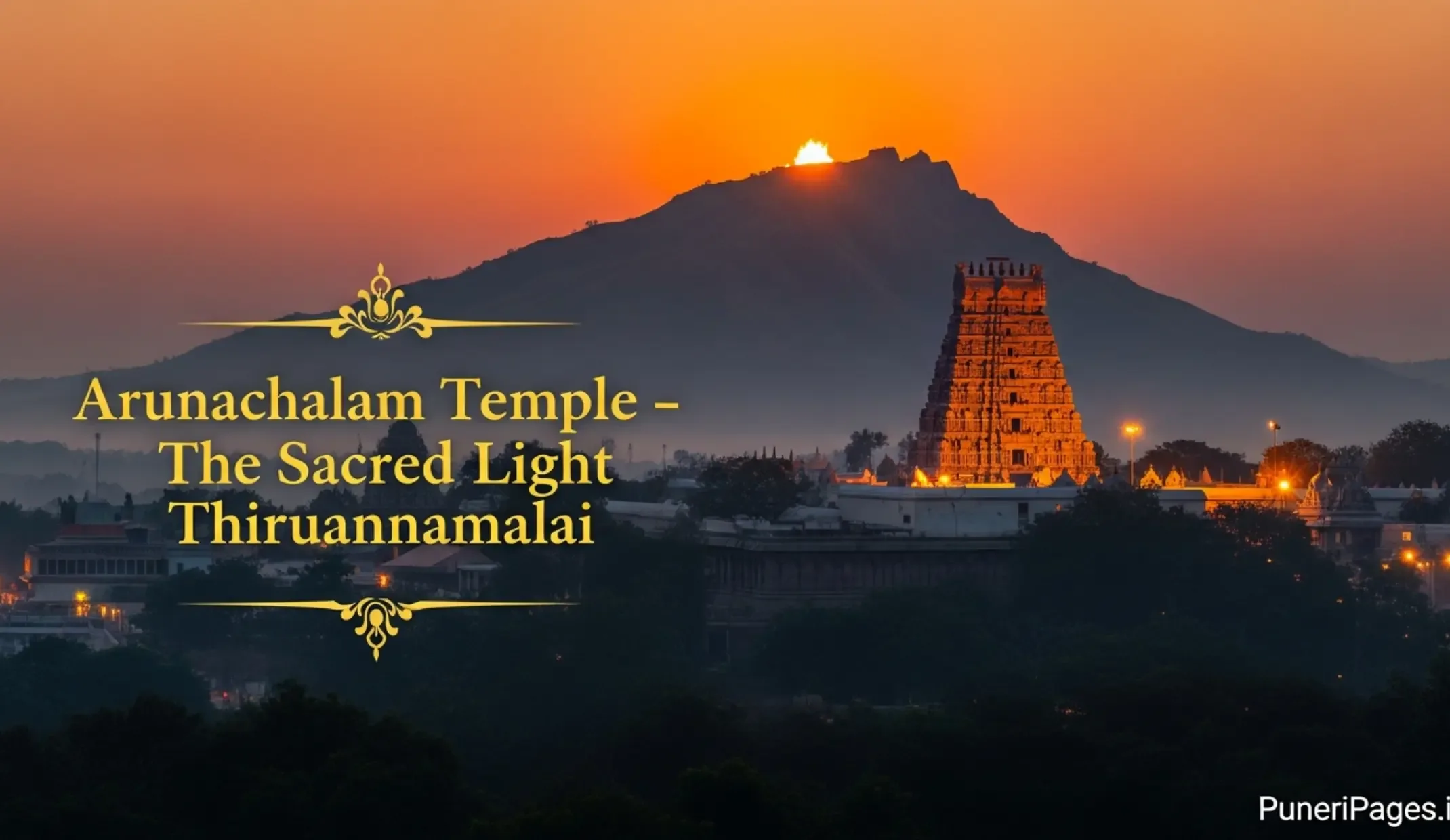
The sacred Arunachalam Temple in Tamil Nadu represents the Agni Lingam — the eternal flame of consciousness.
By Prashant for PuneriPages.in
Nestled at the foothills of Annamalai Hill in Thiruvannamalai, Tamil Nadu, the Arunachalam Temple—also known as Annamalaiyar Temple—stands as one of the most spiritually significant and architecturally majestic shrines in India. Dedicated to Lord Shiva, worshipped here as Arunachaleswarar or the Agni Lingam, this ancient temple is one of the Pancha Bhoota Stalas, representing the element of Fire (Agni).
For millions of devotees, the temple is not just a place of worship but a living embodiment of divine energy, where faith, tradition, and cosmic symbolism merge into one sacred experience. Let us explore in depth what makes Arunachalam Temple so special—spiritually, historically, and culturally.
Table of Contents
1. The Temple of Fire – The Agni Lingam of Shiva
The Arunachalam Temple is celebrated as the Agni (Fire) Lingam, one of the five elemental manifestations of Lord Shiva across South India. The five elements—Earth, Water, Fire, Air, and Space—are represented in the Pancha Bhoota temples, and Arunachalam symbolizes the cosmic energy of fire, denoting illumination, knowledge, and spiritual transformation.
According to legend, Lord Shiva appeared as a column of blazing fire at Thiruvannamalai to settle a dispute between Brahma and Vishnu about supremacy. Neither could find its beginning nor end, leading them to realize the infinite nature of Shiva. The sacred hill of Arunachala itself is believed to be the physical manifestation of that divine fire.
Devotees thus revere the mountain as Lord Shiva in the form of light, and it is worshipped every day as the eternal flame of consciousness.
2. The Sacred Arunachala Hill – Lord Shiva Himself
What truly sets Arunachalam apart is the belief that the hill itself is Shiva. Unlike other temples where deities are confined within sanctums, in Thiruvannamalai, the entire mountain is worshipped as the deity. It radiates spiritual power and is regarded as the center of the universe for seekers pursuing self-realization.
The great saint Ramana Maharshi, who lived at the foot of Arunachala, often said,
“Arunachala is the Heart of the world. It is not a hill of earth; it is the Fire of Knowledge.”
He described the mountain as the Guru in form, whose silent presence guides the devotee toward liberation.
3. The Magnificent Architecture and Grandeur
The Annamalaiyar Temple is one of the largest temples in India, spreading over 25 acres with four majestic gopurams (gateway towers), the tallest being the Eastern Rajagopuram rising to 217 feet—a magnificent Dravidian architectural marvel built during the Vijayanagara Empire.
Architectural Highlights
- 1,000-pillared hall (Aayiram Kaal Mandapam) – A marvel of stone craftsmanship.
- Massive temple tanks such as Brahma Teertham and Sivaganga Teertham.
- Intricate carvings and sculptures depicting Shaivite mythology.
- Five concentric enclosures, symbolizing the five elements and spiritual progression.
The temple’s architectural design reflects spiritual geometry, aligning with the cardinal directions and cosmic principles, ensuring that every structure serves both religious and symbolic significance.
4. Karthigai Deepam – The Festival of Eternal Flame
The Karthigai Deepam festival, celebrated annually in November–December, is the most important and visually stunning festival at Arunachalam. Millions of devotees gather to witness the lighting of the Maha Deepam—a massive beacon flame—on top of the Arunachala Hill.
The flame is visible from miles away and symbolizes Lord Shiva as an infinite pillar of fire. Oil lamps are lit throughout homes and temples, marking the victory of divine light over darkness.
The belief is that seeing the Maha Deepam on this auspicious day grants spiritual liberation (moksha). It represents the eternal light of consciousness that burns within all beings.
5. Girivalam – The Sacred Circumambulation of Arunachala
Girivalam or Giri Pradakshina is one of the most sacred practices performed by devotees. It involves circumambulating the Arunachala Hill, a distance of about 14 kilometers, usually done barefoot during full moon nights.
It is believed that walking around the hill removes karmic sins, purifies the mind, and brings spiritual awakening. Along the path, there are eight Lingams (Ashta Lingams)—each representing different directions and aspects of Shiva:
- Indra Lingam (East) – Brings prosperity
- Agni Lingam (Southeast) – Purifies sins
- Yama Lingam (South) – Grants longevity
- Niruthi Lingam (Southwest) – Removes obstacles
- Varuna Lingam (West) – Provides peace
- Vayu Lingam (Northwest) – Increases vitality
- Kubera Lingam (North) – Bestows wealth
- Ishana Lingam (Northeast) – Leads to spiritual enlightenment
Performing Girivalam during Pournami (Full Moon) is said to have the highest spiritual benefit.
6. Spiritual Significance – Path to Self-Realization
The Arunachalam Temple holds deep spiritual significance beyond rituals and architecture. It represents the inner journey from ego to enlightenment.
In Hindu philosophy, Arunachala symbolizes the “Fire of Knowledge” that burns ignorance (Avidya) and reveals the truth of the Self (Atman). The temple is often visited by spiritual seekers, yogis, and saints who meditate in the caves around the hill, such as:
- Virupaksha Cave – Where Ramana Maharshi meditated for 17 years.
- Skandashram – A serene hermitage with panoramic views of the temple.
These places are considered spiritually charged, where meditation and silence naturally deepen one’s awareness.
7. The Legend of Parvati and Shiva at Arunachala
According to Skanda Purana, when Goddess Parvati playfully closed the eyes of Lord Shiva, darkness engulfed the universe. To restore balance, Shiva appeared as an infinite pillar of fire at Thiruvannamalai.
Parvati, realizing her mistake, performed penance here, and Shiva, pleased with her devotion, united with her as Ardhanarishvara—a form symbolizing the union of divine masculine and feminine energies.
This divine event makes Arunachalam a sacred site for both Shiva and Shakti worshippers, symbolizing the balance of creation and the unity of opposites.
8. Ancient History and Cultural Heritage
The Arunachalam Temple has a history spanning over 2,000 years, with inscriptions from Chola, Pandya, Vijayanagara, and Nayak dynasties. Each era contributed to the temple’s structure, endowments, and rituals.
The temple is also a center for Tamil Saiva tradition, preserving ancient hymns of Tevaram and Thiruvasagam sung by saints like Appar, Sundarar, and Sambandar.
Its rituals follow Agamic traditions, emphasizing purity, Vedic chanting, and daily worship cycles—Kalasanthi, Uchikalam, Sayaraksha, and Ardhajama Poojas.
9. The Global Appeal of Arunachalam
Arunachalam’s magnetic energy has transcended cultures and religions. Spiritual seekers from around the world visit to experience its transformative silence. The teachings of Ramana Maharshi and the message of Self-Enquiry (“Who am I?”) have made Arunachala a global spiritual landmark.
Celebrities, scholars, and monks often visit to experience the divine stillness of Arunachala, which they describe as “the pull of the inner Self manifesting as a mountain.”
10. Why Arunachalam Is Spiritually Special
What makes Arunachalam Temple truly unique is its living divinity.
Unlike most pilgrimage sites centered on rituals or deities, Thiruvannamalai offers a direct connection to the divine Self. Devotees feel a deep silence, a timeless awareness that transcends religion, caste, or culture.
In the words of Ramana Maharshi:
“By merely thinking of Arunachala, one becomes still. The power of Arunachala is that of the Self — it draws you inward.”
This is why seekers across generations call it not just a temple, but the heart of the world, where the eternal flame of consciousness burns bright.
Conclusion – The Eternal Flame of Arunachala
The Arunachalam Temple stands as an everlasting symbol of spiritual illumination and divine truth. It bridges mythology and meditation, devotion and realization. Every stone of this sacred land vibrates with ancient wisdom, and every flame kindled here reminds humanity of the light within.
Whether you visit to perform Girivalam, meditate in silence, or simply experience the divine atmosphere, the Arunachalam Temple promises not just blessings — but awakening.
About The Author