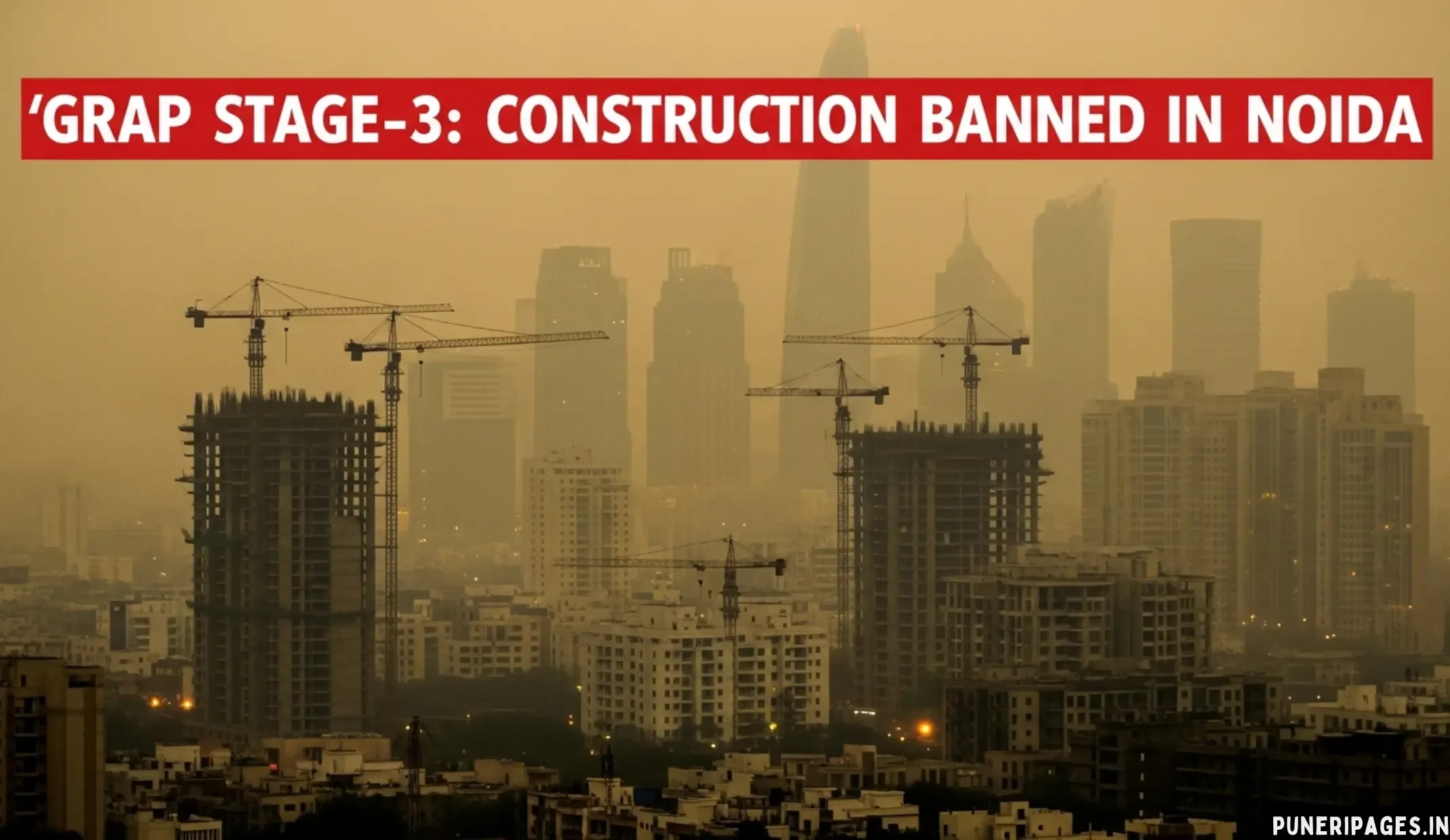
Noida halts all construction and demolition work under GRAP Stage-3 as air quality worsens to ‘severe’ levels.
By Prashant for PuneriPages.in
As air pollution continues to choke the National Capital Region (NCR), the Noida administration has enforced Stage-3 of the Graded Response Action Plan (GRAP), immediately halting all construction and demolition activities across the city. The decision follows the alarming deterioration of air quality, with the Air Quality Index (AQI) slipping into the ‘severe’ category, raising health concerns and prompting urgent preventive measures.
The implementation of GRAP Stage-3 is one of the most stringent anti-pollution steps taken under India’s environmental management framework. This step, in coordination with the Commission for Air Quality Management (CAQM), aims to reduce particulate matter emissions and prevent further degradation of air quality in Delhi, Noida, Ghaziabad, and Gurugram.
Table of Contents
Understanding GRAP Stage-3 and Its Enforcement
The Graded Response Action Plan (GRAP) is a dynamic framework designed to curb air pollution based on real-time AQI levels. Stage-3 is triggered when the AQI remains in the “Severe” range (401–450) for over 48 hours, indicating high concentrations of PM2.5 and PM10 pollutants in the air.
Key Restrictions Under GRAP Stage-3
Under the latest directives issued by the CAQM and implemented by the Noida Authority, the following restrictions have been enforced:
- Immediate suspension of all construction and demolition (C&D) activities — except for those deemed essential, such as:
- National security projects
- Metro, railway, and airport construction
- Defense infrastructure
- Hospital and healthcare-related projects
- Ban on mining, stone crushing, and earthworks across Noida and Greater Noida.
- Closure of brick kilns and hot-mix plants using coal or other polluting fuels.
- Regulated movement of heavy and medium commercial vehicles to reduce emissions from diesel engines.
- Enhanced mechanical road sweeping and water sprinkling operations to control dust resuspension.
Authorities have also deployed enforcement teams to monitor construction sites, industrial units, and transport corridors for compliance with GRAP protocols. Violators may face heavy penalties and legal action under environmental protection laws.
Why Noida’s Air Quality Turned ‘Severe’
The deterioration in Noida’s air quality is attributed to multiple overlapping factors.
1. Meteorological Conditions
The onset of winter inversion has trapped pollutants close to the surface, significantly reducing dispersion. Calm wind speeds and lower nighttime temperatures have intensified smog accumulation.
2. Vehicular Emissions
According to recent reports by the Central Pollution Control Board (CPCB), vehicular pollution remains a major contributor, accounting for nearly 40% of PM2.5 emissions in the NCR. The high number of diesel-powered commercial vehicles and last-mile connectivity autos exacerbate the problem.
3. Construction Dust
Construction sites in Noida and Greater Noida have been key pollution hotspots. Dust from unregulated material storage, uncovered transport, and debris disposal contributes to particulate matter buildup.
4. Stubble Burning in Neighboring States
Agricultural residue burning across Punjab, Haryana, and western Uttar Pradesh adds a seasonal layer of pollution. The prevailing northwesterly winds carry these pollutants into NCR, worsening air quality.
5. Industrial Pollution
Unauthorized or inefficient small-scale industries operating with outdated emission controls also add to the particulate load.
AQI Data: How Bad Is the Air in Noida Right Now?
As per the System of Air Quality and Weather Forecasting and Research (SAFAR), the Noida AQI has surged to above 450, marking the “Severe” category threshold.
| Area | AQI Level | Status |
|---|---|---|
| Sector 62 | 462 | Severe |
| Sector 16A | 445 | Severe |
| Greater Noida (Alpha 1) | 438 | Severe |
| Noida Expressway | 457 | Severe |
| Film City | 430 | Severe |
Experts warn that exposure to this level of air pollution can cause severe respiratory distress, eye irritation, and long-term health complications, particularly for children, the elderly, and individuals with pre-existing conditions.
Health Advisory for Residents
Given the high-risk pollution levels, medical authorities and the Noida Health Department have issued specific health advisories:
- Limit outdoor activities during early morning and late evening hours.
- Wear certified N95 masks when stepping outdoors.
- Use air purifiers indoors to reduce particulate matter exposure.
- Stay hydrated and avoid intense physical exercise in open spaces.
- Seek immediate medical attention if experiencing breathlessness, coughing, or dizziness.
Hospitals across Noida have also reported an increase in OPD cases linked to pollution-related ailments such as asthma, bronchitis, and throat infections.
Government and Civic Response
The Noida Authority and Uttar Pradesh Pollution Control Board (UPPCB) have intensified ground surveillance to ensure the immediate execution of GRAP norms.
Key Measures Taken
- Deployment of anti-smog guns at major intersections, flyovers, and construction hubs.
- Increased frequency of road washing and dust suppression drives.
- Real-time monitoring through the Integrated Command and Control Center (ICCC).
- Collaboration with RWAs and local societies to reduce generator and garbage burning activities.
Officials have also confirmed that environmental compensation fines will be imposed on defaulters violating GRAP rules.
How Long Will GRAP Stage-3 Remain in Force?
The Stage-3 restrictions will remain in effect until air quality shows sustained improvement for at least 48–72 hours, as per CAQM’s monitoring mechanism. If pollution levels worsen further — pushing AQI beyond 450 — authorities may consider invoking GRAP Stage-4, which involves a complete ban on non-essential vehicular movement and industrial operations.
Meteorological forecasts indicate a possible slight improvement over the next few days, depending on wind speed and humidity levels. However, consistent enforcement remains key to ensuring measurable relief.
Impact on Construction and Real Estate Sector
The temporary ban on construction and demolition activities is expected to impact real estate developers and contractors in the region. Ongoing projects in Noida, Greater Noida, and Yamuna Expressway are facing delays as work halts mid-progress.
However, industry experts believe that short-term disruptions are necessary for long-term environmental stability. Developers have been advised to adopt dust containment systems, material covering, and on-site recycling units to comply with green norms post-ban.
Citizen Initiatives and Public Awareness
Amid the crisis, several citizen groups, environmental NGOs, and RWAs in Noida have begun mobilizing awareness campaigns.
Key initiatives include:
- Tree plantation drives and green wall installations.
- Awareness workshops on sustainable commuting and waste management.
- Air quality monitoring apps to promote citizen participation in pollution tracking.
Such collaborations highlight the importance of community-led actions in complementing government efforts to combat the pollution crisis.
A Call for Sustainable Urban Action
The enforcement of GRAP Stage-3 in Noida underscores the urgent need for long-term sustainable urban planning. While temporary bans offer short-term relief, the solution lies in systemic reforms — including better public transport systems, cleaner fuel transitions, and strict emission standards.
As air quality in Noida hovers in the “severe” range, authorities, industries, and citizens must collaborate toward achieving a cleaner, healthier NCR. The current crisis serves as a stark reminder that air pollution is not just an environmental issue but a public health emergency demanding consistent, coordinated action.
About The Author